

Mass Flow Controllers (MFCs) are among the most important instruments used in industrial automation, gas analysis systems, semiconductor manufacturing, pharmaceutical processes, environmental monitoring, and calibration laboratories. These devices are designed to measure and control gas flow rates with high precision under specific operating conditions.
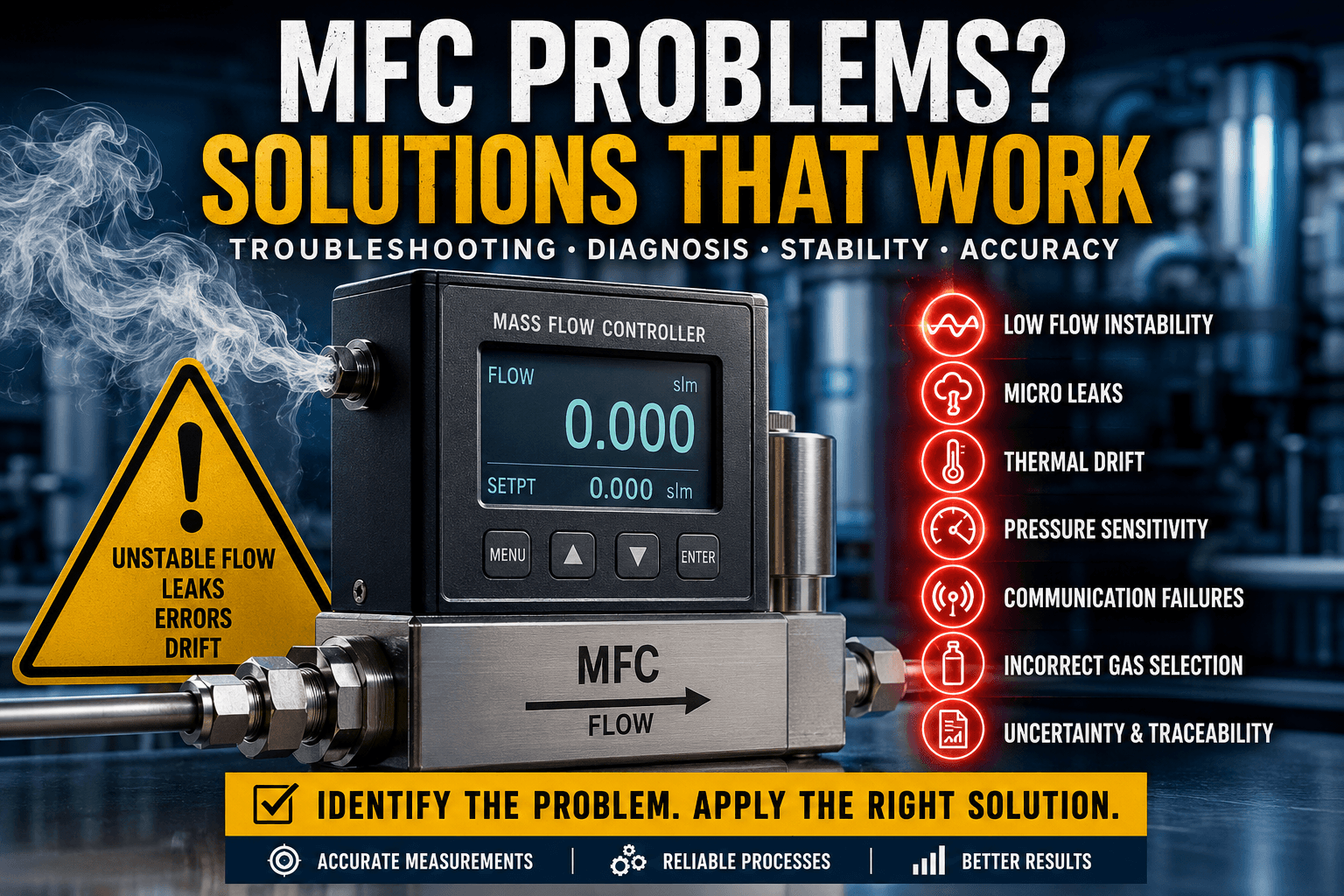
Despite their importance and widespread use, Mass Flow Controllers are also known for presenting complex technical problems that can affect measurement accuracy, process stability, and calibration reliability. In many industrial laboratories, technicians and engineers frequently encounter issues such as unstable low-flow readings, thermal drift, communication failures, pressure sensitivity, and unexplained calibration deviations.
In high-precision applications, even small problems can generate large uncertainty contributions or force equipment out of specification. For this reason, understanding the most common MFC problems and their possible solutions is essential for improving system reliability and maintaining traceable measurements.
This article explores the most frequent technical problems experienced with Mass Flow Controllers in real industrial and laboratory environments, including practical troubleshooting recommendations and engineering solutions.
1. Low Flow Calibration Instability in Mass Flow Controllers
One of the most difficult challenges in Mass Flow Controller calibration is achieving stable and repeatable measurements at very low flow rates. Many laboratories report excessive instability, fluctuating readings, random deviations, or inconsistent repeatability when calibrating low-flow points.
Low-flow calibration problems are especially common in:
- Environmental monitoring systems
- Gas dilution systems
- Air quality analyzers
- Pharmaceutical gas processes
- Semiconductor applications
- Precision gas blending systems
At very low flows, the system becomes highly sensitive to external disturbances. Small pressure changes, thermal fluctuations, or micro leaks that appear insignificant at higher flow rates may dramatically affect the measurement.
Common Symptoms of Low Flow Instability
Technicians often observe:
- Unstable flow readings
- Oscillating measurements
- Increased uncertainty
- Difficulty reaching setpoints
- Poor repeatability
- Slow stabilization times
- Excessive calibration errors
In some situations, the instability appears random, making troubleshooting even more complicated.
Possible Causes of Low Flow Problems
Several factors may contribute to low-flow instability in MFC systems:
- Micro leaks in fittings or tubing
- Thermal instability
- Pressure fluctuations
- Contaminated sensors
- Flow turbulence
- Incorrect tubing dimensions
- Electrical noise or grounding problems
- Insufficient stabilization time
Because low-flow calibration is extremely sensitive, engineers should never underestimate environmental or system-related factors.
Possible Solutions for Low Flow Calibration Issues
To improve low-flow stability, laboratories should consider:
- Inspecting all fittings and gas connections
- Increasing stabilization time before measurements
- Reducing unnecessary tubing lengths
- Improving pressure regulation
- Controlling laboratory temperature
- Isolating electrical noise sources
- Verifying grounding integrity
- Using high-quality leak detection methods
Low-flow calibration often requires patience, controlled environmental conditions, and a systematic troubleshooting process.
2. Micro Leaks in MFC Gas Systems and Their Impact on Calibration
Micro leaks are one of the most difficult technical problems to identify in Mass Flow Controller systems. Even extremely small leaks can significantly affect low-flow measurements and increase calibration uncertainty.
In many industrial laboratories, technicians perform basic soap-bubble testing and conclude that the system is leak-free. However, tiny leaks may still exist and remain undetectable using conventional methods.
Why Micro Leaks Are Dangerous
Micro leaks can produce:
- Flow instability
- Random measurement deviations
- Drift over time
- Slow response behavior
- Inability to maintain setpoints
- Increased uncertainty
- Incorrect calibration results
At low flows, the influence of a small leak becomes proportionally much larger.
In some cases, the MFC itself is not defective. The actual problem originates from:
- Tubing connections
- Compression fittings
- Solenoid valves
- Damaged O-rings
- Pressure regulators
- Internal contamination
Best Practices for Leak Detection in MFC Systems
For critical applications, laboratories should implement more advanced leak detection procedures such as:
- Helium leak testing
- Pressure decay testing
- Vacuum integrity testing
- Preventive fitting replacement
- Inspection of aging tubing
Routine preventive maintenance is extremely important for minimizing leak-related problems in industrial gas systems.
3. STP vs NTP Confusion During MFC Calibration
One of the most underestimated problems in gas flow calibration involves confusion between Standard Temperature and Pressure (STP) and Normal Temperature and Pressure (NTP).
Different manufacturers define reference conditions differently:
- STP may refer to 0°C and 1 atm
- NTP may refer to 20°C or 25°C
- Some systems use custom reference conditions
If technicians fail to verify the reference condition used by the MFC manufacturer, calibration results may appear incorrect even when the instrument is functioning properly.
Why Reference Conditions Matter in Gas Flow Measurement
Gas density changes according to temperature and pressure. Since Mass Flow Controllers calculate flow using gas properties, changing the reference condition directly affects the indicated flow value.
This issue becomes especially critical when comparing:
- Different manufacturers
- Different calibration laboratories
- Environmental analyzers
- Flow transfer standards
How to Avoid STP and NTP Errors
Laboratories should:
- Verify manufacturer specifications carefully
- Document reference conditions clearly
- Include STP/NTP definitions in calibration reports
- Train technicians about gas reference standards
- Confirm software configuration settings
Many calibration discrepancies are caused by reference condition confusion rather than actual equipment malfunction.
4. Communication Problems in Digital Mass Flow Controllers
Modern industrial Mass Flow Controllers frequently use digital communication protocols such as:
- RS-232
- RS-485
- Modbus
- DeviceNet
- Ethernet/IP
Communication failures may interrupt industrial processes or completely prevent calibration procedures.
Common Communication Failure Symptoms
Typical communication problems include:
- Loss of connection
- Delayed responses
- Invalid commands
- Random disconnections
- Software freezing
- Unstable readings
These problems are particularly common in industrial environments with high electromagnetic interference.
Main Causes of MFC Communication Failures
Possible causes include:
- Incorrect baud rate settings
- Damaged communication cables
- Faulty serial converters
- Poor shielding
- Ground loops
- Electromagnetic interference (EMI)
- Improper termination resistors
Variable frequency drives, motors, and industrial power systems may generate electrical noise capable of affecting communication stability.
Recommended Solutions for MFC Communication Issues
Engineers should:
- Verify protocol settings carefully
- Improve cable shielding
- Separate signal cables from power cables
- Inspect grounding systems
- Test isolated communication converters
- Update firmware when available
Reliable communication is essential for industrial automation systems and remote calibration processes.
5. Thermal Drift and Temperature Effects in Mass Flow Controllers
Thermal Mass Flow Controllers are highly dependent on stable temperature conditions. Environmental temperature fluctuations may produce measurement drift, instability, and repeatability problems.
Many laboratories observe that calibration results change during the day due to ambient temperature variation.
Common Symptoms of Thermal Drift
Thermal-related problems may include:
- Gradual flow deviation changes
- Long-term instability
- Different results at different times
- Excessive repeatability errors
- Increased uncertainty
How to Reduce Thermal Drift in MFC Systems
To minimize thermal effects, laboratories should:
- Stabilize room temperature
- Avoid direct airflow over instruments
- Increase instrument warm-up time
- Monitor ambient conditions continuously
- Use temperature-controlled environments
Thermal stabilization is one of the most important factors in high-precision flow calibration.
6. Pressure Instability and MFC Performance Problems
Pressure fluctuations can strongly affect Mass Flow Controller performance, especially in low-flow applications.
Some MFCs are extremely sensitive to:
- Inlet pressure changes
- Outlet restrictions
- Backpressure variation
- Pulsating compressors
Symptoms of Pressure-Related Problems
Technicians may observe:
- Flow oscillation
- Unstable setpoints
- Increased calibration errors
- Slow response times
- Poor repeatability
Recommended Solutions
Possible solutions include:
- Installing high-quality pressure regulators
- Reducing pressure fluctuations
- Using proper tubing dimensions
- Increasing stabilization times
- Verifying backpressure conditions
Stable pressure conditions are essential for accurate gas flow control.
7. Incorrect Gas Selection and Gas Correction Factor Errors
Many Mass Flow Controllers are calibrated for specific gases such as nitrogen. Using a different gas without proper correction factors can generate significant measurement errors.
Gas thermal properties directly affect sensor behavior.
Common Mistakes in Gas Selection
Industrial users often:
- Use incorrect gas tables
- Apply wrong correction factors
- Ignore manufacturer recommendations
- Assume all gases behave similarly
How to Prevent Gas Configuration Errors
Laboratories should:
- Verify gas compatibility
- Use manufacturer correction tables carefully
- Confirm software gas configuration
- Recalibrate when necessary
Incorrect gas configuration is one of the most common causes of unexpected MFC errors.
8. Measurement Uncertainty and Traceability Challenges in MFC Calibration
Many laboratories underestimate the uncertainty contributions associated with Mass Flow Controller calibration.
Important uncertainty sources include:
- Temperature variation
- Pressure instability
- Micro leaks
- Repeatability
- Resolution
- Reference standard uncertainty
- Environmental conditions
Without proper uncertainty analysis, calibration results may become unreliable or non-traceable.
Improving Measurement Reliability and Traceability
Laboratories should:
- Develop complete uncertainty budgets
- Use traceable reference standards
- Improve stabilization procedures
- Monitor environmental conditions carefully
- Perform repeatability studies
Metrology principles are fundamental for obtaining reliable flow measurements in industrial applications.
Final Thoughts on Mass Flow Controller Problems and Troubleshooting
Mass Flow Controllers are essential instruments for industrial gas control and precision flow measurement. However, they also present complex technical challenges that require systematic troubleshooting and strong engineering knowledge.
Many MFC problems are not caused directly by the controller itself. Instead, the root cause often involves:
- Micro leaks
- Thermal instability
- Pressure fluctuations
- Communication failures
- Incorrect reference conditions
- Gas configuration errors
Understanding these problems allows laboratories and industrial technicians to improve calibration reliability, reduce uncertainty, and maintain traceable measurements.
As industrial automation, environmental monitoring, and precision gas applications continue to grow worldwide, the importance of proper MFC troubleshooting and calibration practices will become even greater.